
Spray foam insulation is increasingly flagged by surveyors and mortgage lenders across the UK, often preventing property sales or remortgaging.
If you have discovered spray foam insulation in your loft, you are likely aware of the challenges it presents—from trapping moisture and rotting roof timbers to making it nearly impossible to secure a mortgage or release equity.
At Foam Free Lofts, we specialise in the safe and effective extraction of all types of spray foam. Every roof is unique, and the removal process depends heavily on the type of foam used and what it was sprayed onto. To help you understand what to expect, here is a breakdown of the three most common scenarios we encounter and how we handle them.


Prevents trapped moisture and timber decay, safeguarding the long-term integrity of your roof.

Helps satisfy surveyors and lenders, making your property easier to sell or remortgage.

Allows your roof space to breathe properly, reducing damp and condensation risks.

Tackles potential structural issues early—saving you from expensive problems down the line.

Done without damaging your roof

Increases buyer confidence and appeal
We begin by identifying the type of spray foam (open-cell or closed-cell), the extent of coverage, site access, and the likely condition of the underlying timbers.
The working area is carefully prepared using protective sheeting, ventilation controls, and HEPA-filtered extraction equipment to manage dust and airborne particles.
The foam is removed methodically using hand tools only, working across the roof structure in a controlled and systematic way to avoid damage to the timbers.
Once the bulk of the foam is removed, the timbers are carefully cleaned to remove remaining residue so the full condition of the wood can be clearly assessed.
With the structure fully exposed, all roof timbers are inspected for signs of damp, mould, rot, or hidden deterioration that may have been concealed by the foam.
If we identify any decayed or deteriorating timbers or battens during the removal process, we can carry out the necessary repairs. Please note that any additional repair work required would be quoted separately and would not be included within the original foam removal quote.
Airflow at the eaves and soffits is restored to re-establish proper roof ventilation and help prevent future condensation issues.
All removed spray foam is treated as controlled waste and disposed of safely through licensed waste facilities.
We provide a certificate confirming full removal, supported by photographic evidence and an assessment of the timber condition.
As part of the work, we are required to install a minimum of half a roll of insulation to meet current regulations, and this is included within the job cost. If you would like a full loft re-insulation, this would be an additional upgrade.
Guidance from the House of Commons Library, which provides research support to UK Parliament, indicates that spray foam insulation in roof spaces does not typically make a property unmortgageable. Instead, it is more likely to restrict the range of lenders willing to consider a mortgage, rather than removing eligibility altogether
(Source: House of Commons Library).
A BBC News investigation published in November 2024 examined the position of the UK’s 20 largest mortgage lenders. It found that while lending policies vary, a number of mainstream lenders and all equity release providers included in the survey would not lend on properties with spray foam insulation in the roof. The BBC reporting highlights that decisions are inconsistent across the market and depend on individual lender criteria at the time of application.
(Source: BBC News)
Professional guidance from the Royal Institution of Chartered Surveyors (RICS) notes that spray foam insulation can affect mortgage valuations and survey outcomes. RICS explains that this is primarily because the insulation can conceal roof timbers, limiting the surveyor’s ability to carry out a full visual inspection. It also cautions that, in some cases, poorly installed foam may trap moisture and hide developing issues such as timber decay.
(Source: RICS guidance)

There are two main types of spray foam insulation, and the distinction between them is one of the most important factors to understand.
Open-cell foam is soft, lightweight, and sponge-like. It has a lower density and is vapour-permeable, which means moisture can pass through it. It is primarily used for thermal insulation and is the most commonly installed type in UK homes today.
Closed-cell foam is much denser and rigid in structure. It is vapour-resistant (approaching vapour-tight) and provides both insulation and structural benefits. In some cases, it has been used to help stabilise roof coverings, including securing loose or slipping tiles.
This difference matters because the performance and risk profile of spray foam depends heavily on how it interacts with the existing roof build-up, such as breathable membranes, bitumen felt, or traditional tile structures. Research commissioned by UK building safety authorities, including the Building Safety Regulator (2024), indicates that moisture risks vary depending on installation type and roof configuration, meaning outcomes are highly dependent on design and workmanship rather than the material alone.
If you’re unsure which type of spray foam insulation is present in your property, get in touch with our team for expert advice and guidance.
Closed cell foam is a dense, rigid material that sets rock-hard. In older roofs that do not have a protective layer of roofing felt, this foam was often sprayed directly onto the underside of the roof tiles and the wooden battens holding them in place. It effectively acts as a heavy-duty glue.
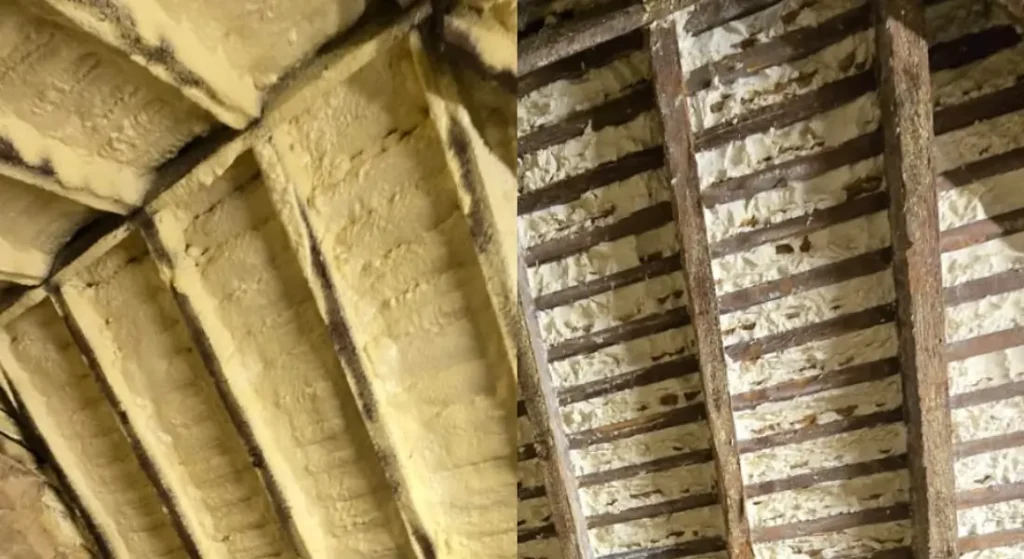
This is the most complex and delicate removal process. Because the hard foam is bonded directly to the tiles and timber battens, our team must painstakingly scrape, cut, and carefully chip the foam away by hand or with specialized tools to separate it from the roof structure.
Completely restores vital airflow to your roof, halts any hidden timber rot, and is the only way to make the property viable for mortgage lenders again.
Because the foam binds the tiles together, removing it carries a risk of cracked tiles or damaged battens. While our team works with extreme care to minimize this, customers should be aware.
In this scenario, the dense, hard closed cell foam was sprayed onto the roofing felt (the membrane that sits between your rafters and the tiles).
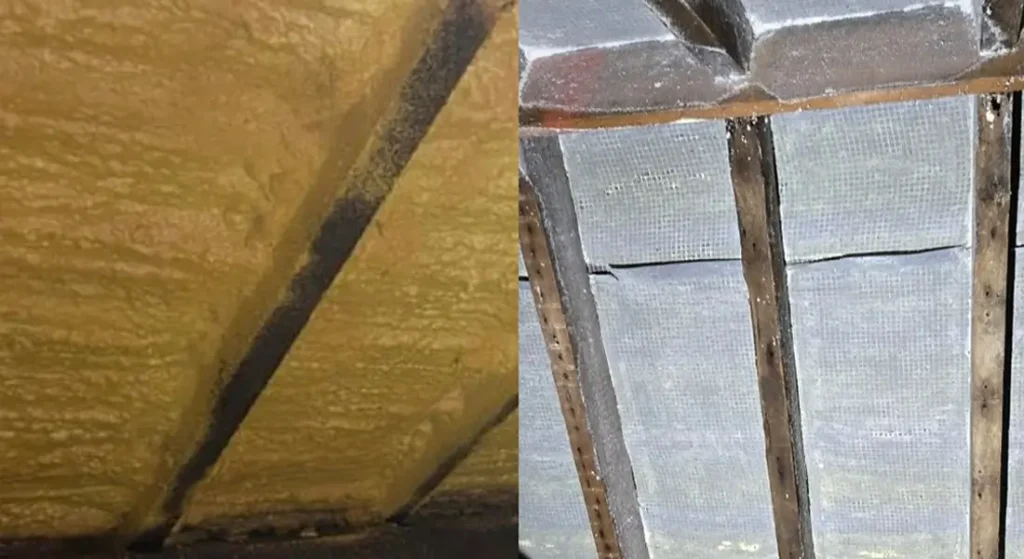
Because closed cell foam adheres aggressively to whatever it touches, it chemically bonds to the felt. To remove the foam completely and satisfy surveyor standards, we generally have to carefully cut and remove the sections of felt that the foam is attached to, working meticulously between each wooden rafter. We then clean the exposed rafters of any remaining residue.
Highly effective at uncovering the rafters so they can breathe and be properly inspected for dampness or rot by a surveyor. It poses less direct risk to your external roof tiles compared to direct-to-tile foam.
The removal process usually results in the loss of the roofing felt in the sprayed areas. While your roof tiles will still keep the weather out, you will lose that secondary membrane layer, unless the foam hasn’t bonded to the felt, in this case it is saved.
Open cell foam is much lighter, softer, and more sponge-like than closed cell foam. It is typically sprayed directly onto the roofing felt between the rafters. While it is softer, it can still trap moisture against the timber and block vital ventilation, which is why lenders still require its removal.
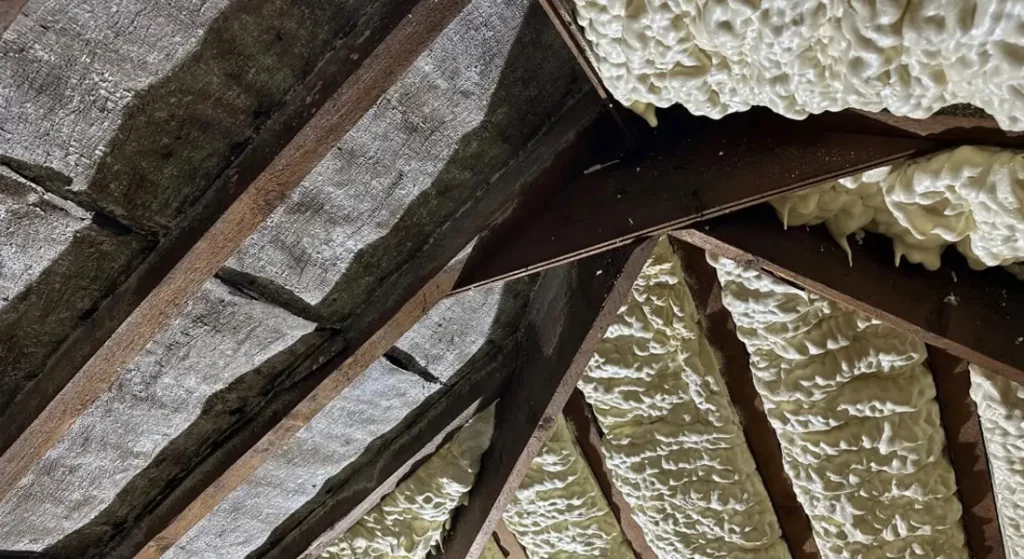
Because of its softer consistency, open cell foam is significantly easier to manipulate. Our team can cut, scrape, and brush this foam away from the felt and rafters with a higher degree of speed. Depending on the condition of the felt and how the foam was applied, we can sometimes save the felt, though it often still needs to be removed if the foam has penetrated/ dampened the membrane due to unforseen issued underlying.
Generally a faster and less disruptive process than closed cell removal. It leaves a very clean finish on the rafters, making it highly successful for passing RICS surveyor inspections.
Like all spray foam removal, it is a dusty and messy process. Even though the foam is softer, the structural integrity of older roofing felt may still be compromised during the cleaning process.
Most projects typically take between one and three days to complete, with a standard loft usually requiring around two to five days depending on the type of foam, its thickness, and the complexity of the roof structure. Larger or more complex roofs, or those where timber repairs are uncovered during the removal process, may take five days or longer.
Closed-cell foam generally takes longer to remove than open-cell foam due to its denser, more rigid structure and stronger adhesion.
The method of removal is critical, both for protecting your roof timbers and ensuring the work is acceptable to mortgage lenders.
The industry-standard and lender-approved approach is manual, hand-tool removal. This involves carefully cutting, peeling, and scraping away the foam using tools such as chisels, scrapers, and putty knives. No power tools, heat, or chemicals should be used, as these can damage, scorch, or compromise the timber. For lender purposes, removal certificates must clearly confirm that a manual-only process was used and that no chemicals were involved.
Why this really matters;
Open-cell foam is generally softer and can often be removed in sections by carefully peeling it away from the timber and roof surfaces, although it is still a labour-intensive process.
Closed-cell foam is far more rigid and strongly bonded, making it significantly more difficult to remove. Extra care and time are required to prevent damage to the underlying structure.
While mechanical methods such as dry-ice blasting may be used in some cases for heavily bonded closed-cell foam, they can create issues if referenced on certification and may not be accepted by some lenders. Where any mechanical assistance is required, the timber should always be fully finished by hand and the process properly documented to maintain certification validity.
The priority throughout is a complete, clean removal that leaves all timbers fully exposed, sound, and ready for inspection — not a rushed process that risks structural damage.
As a general guide, costs typically range from £40 to £75 per square metre, with a standard three-bedroom property’s loft usually costing between £3,000 and £7,500. In more complex cases, where extensive timber repairs are required, costs can rise to £15,000–£25,000, although these situations are relatively uncommon.
Because removal often requires considerably more labour than the original installation, it can cost as much as—or even more than—the insulation itself.
(Source: Checkatrade 2026)
Not every property with spray foam insulation needs to have it removed. The level of risk depends largely on how the insulation was installed and the type of roof construction, rather than simply the presence of spray foam itself.
Situations Where Removal May Be Recommended
Open-cell spray foam has been applied directly to a high-resistance underlay, such as bitumen felt, without a suitable air and vapour control layer (AVCL). Research has shown this type of construction can increase the risk of condensation and timber decay over time.
Spray foam has been applied directly onto roof tiles or slates. This is considered one of the highest-risk installation methods, with the potential for moisture-related damage to roof timbers, battens, and tile fixings.
There are no installation records, the type of foam or roof underlay is unknown, or there are visible signs of damp, mould, condensation, or timber deterioration.
Situations Where Removal May Not Be Required
The spray foam system was designed and installed in accordance with BS 5250:2021, using the correct combination of insulation, roof underlay, ventilation, and vapour control measures.
The insulation was installed as part of a new-build property, an approved loft conversion, or as part of a recognised roofing system, such as certain historical tile-bonding applications.
The installation is fully documented and certified, was completed by an approved installer, and the roof shows no evidence of damp, condensation, or timber decay during inspection.
Every Property Should Be Assessed Individually
Spray foam insulation is a polyurethane material that expands and hardens in place, forming a strong bond with timber, brick, and other building materials. While it is highly effective for insulation and air sealing, there are situations where removal may be necessary, such as property sale complications, ventilation or moisture issues caused by incorrect installation, or when access is required for repairs or renovation work.
Although it is technically possible to remove spray foam insulation yourself, it is a challenging and often time-consuming task. The material adheres strongly to surfaces and can be difficult to remove fully, particularly in tight or awkward spaces. The process also requires appropriate tools, protective equipment, and care to avoid damaging underlying roof timbers or structures. For larger areas, or where the installation is extensive, professional removal is often the safer and more efficient option, ensuring the work is completed thoroughly and in line with property and safety requirements.


